Naoshima Meeting
2025
From Bringing to Venice What
Marco Polo Forgot to the
Naoshima New Museum of Art:
The Trajectory with Asian
Contemporary Art 1995–2025
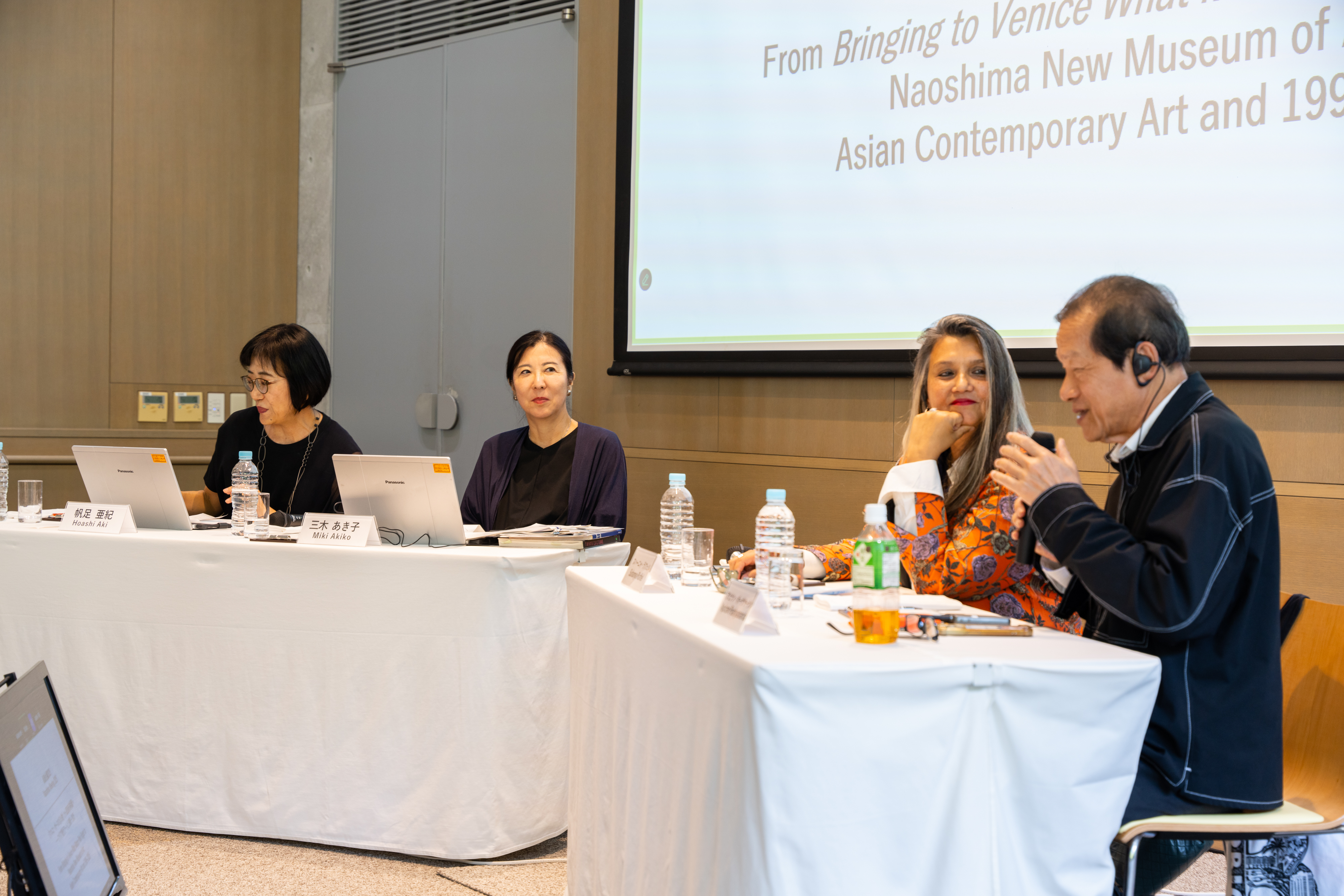
Naoshima Meeting
2025
From Bringing to Venice What
Marco Polo Forgot to the
Naoshima New Museum of Art:
The Trajectory with Asian
Contemporary Art 1995–2025
-
4. Presentation by Apinan Poshyananda
Presentation by Apinan Poshyananda
Apinan Poshyananda:
Hello everyone. It's great to be here, and I just want to say that I envy your life in Naoshima. Yesterday, I had the chance to go by boat to Teshima and around Naoshima. Not only do you enjoy beautiful weather, but you are also surrounded by culture, nature, and contemporary art, and you live in good health. Everyone looks so healthy. It's amazing how art, nature, and environment mesh together. You are living with art, not just looking at it, because art reflects life. I think that, when we look at the entire history of contemporary art, it makes us truly appreciate Naoshima. All this environment is about human nature, how we touch one another. We appreciate Naoshima because it looks out to the world, and we can realize that the world looks to Naoshima, because the world is collapsing.
Our world is full of catastrophes and calamities, sorrow, and fighting. People want to escape, to be near nature and loved ones. Art can also be there for us, just like our families and companions, even when we don't understand what the artist is trying to say, because the artists themselves sometimes don't know what they're saying. Art can instead just be a catalyst for rejuvenation.
I would like to express what the TransCulture exhibition taught me. I was in Venice, at the invitation of Akiko and Fumio Nanjo, to be part of this amazing project. The word "transculture" implies many cultures, not just one nation. Because the Venice Biennale focused on national pavilions, there was a feeling of "me, me, me," which greatly confined our boundaries. But the TransCulture exhibition was broader, and artists of many nationalities were involved. At the time, it was highly innovative to show many artists. We saw this already with Cai Guo-Qiang, and there were also emerging artists like the very young Takashi Murakami. Among them were the duo Alwin Reamillo and Juliet Lea, based in the Philippines and Australia, who were creating installations about colonialism and Catholicism. At the time, it was unusual and innovative for the Venice Biennale to present works on such themes by artists from Southeast Asia and Australia.
Regarding the impact of the TransCulture exhibition, 29 years later, I curated an exhibition called The Spirits of Maritime Crossing in Venice. This was at the 60th International Art Exhibition ー La Biennale di Venezia. Drawing inspiration from TransCulture, I held this exhibition at the Palazzo along the Grand Canal. There were fifteen artists from countries including Vietnam, Thailand, Laos, the Philippines, Indonesia, Singapore, and Malaysia. The theme of the big show at the Biennale Arte was "Foreigners Everywhere," but we wanted to express that foreigners were not everywhere, because the main venues did not select many foreign artistsーartists from small countries. Even so, the idea of placing our artworks in the historic palazzo was an idea I learned from the TransCulture exhibition.
Here are some more works by Singaporean and Thai artists. By the way, some of the artists I am about to introduce are involved in the projects here in Naoshima, such as Pannaphan Yodmanee and Sanitas Pradittasnee.
I would also like to very quickly show you another project I was involved with, one called the Bangkok Art Biennale. This launched in 2018, including works by Yayoi Kusama and Anish Kapoor. We have had four of these exhibitions so far, and our fifth will be next year. We have had very strong contributions from Japanese artists, with Tatsuo Miyajima being involved in our last one. We have now had an average of over a million visitors per edition of the Bangkok Art Biennales, partly because people can enter our Biennales free of charge. I think this is a significant factor, because when admission is free, it encourages people to come again. It also allows young people to get involved, bringing along their families and other loved ones.
Some people say they come to the Bangkok Art Biennale to relax, something they can do because visitors don't have to understand everything about contemporary art. Another strength is that we showcase artworks in temples and in heritage sites, places like the Temple of the Reclining Buddha and the Temple of Dawn, and in major palaces and royal temples along the Chao Phraya River. This helps draw a variety of works from all over the world. We have artists from Nigeria, from New Zealand, from Canada... We also show works according to a theme set for the year.
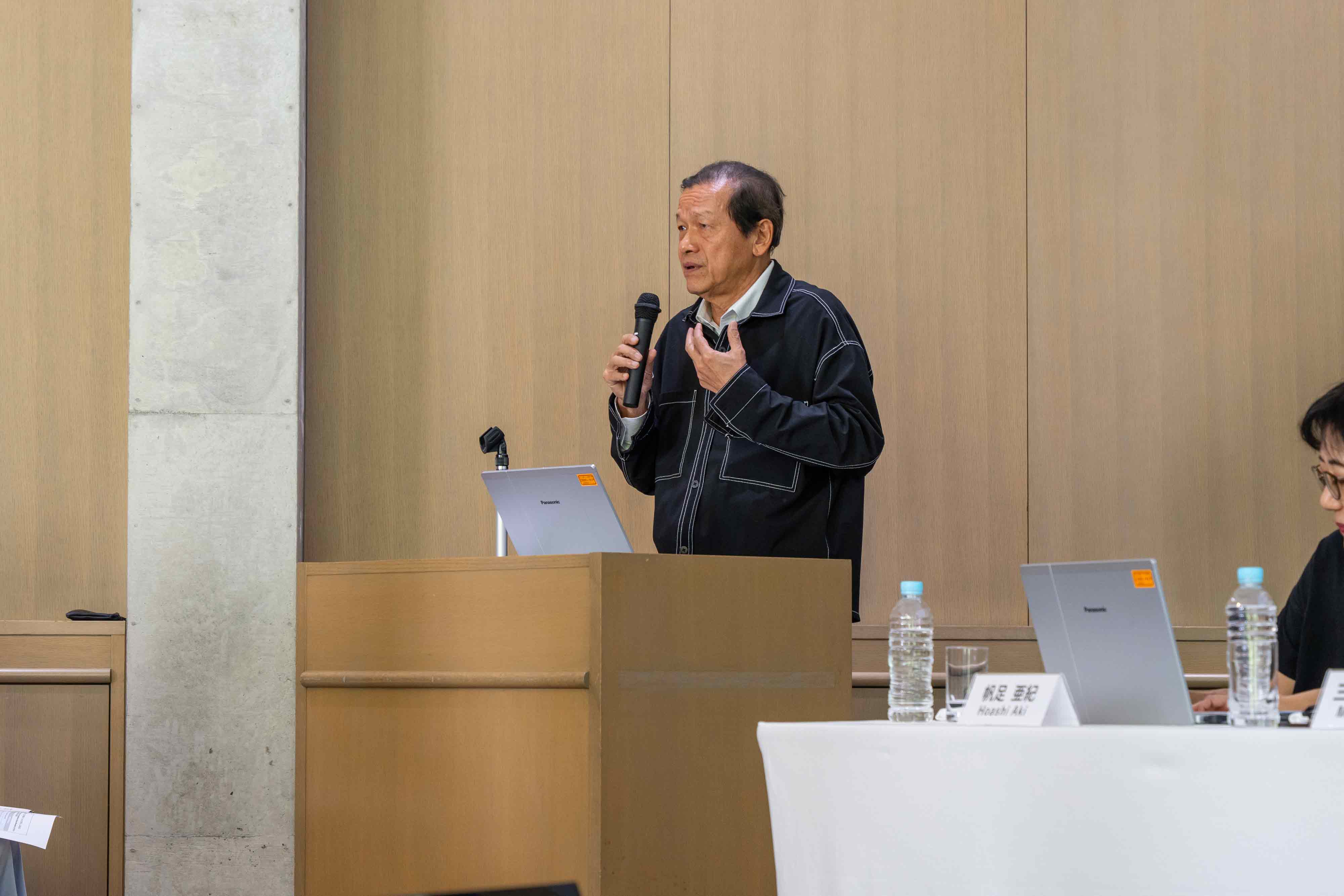
I also want to touch on our community of artists, audiences, and volunteers. Volunteers are very important. They come to explain the works, allowing communication with our visitors. We both train and pay them. During the four to five months of the event, many young people get involved. To briefly touch on participating Japanese artists, as you know, Yoshitomo Nara exhibited at our first Bangkok Art Biennale in 2018. He showed his work in a garden. Seventeen of Kusama's pumpkins were placed not in a temple, but in a department store. Many would consider showing artworks in a department store as unacceptable, saying that contemporary art belongs in galleries or museums. But Japan was one of the first countries where artworks were displayed in department stores. Department stores are a place where people can walk around, enjoying fashion and design, so Kusama's works were a big hit, because people could communicate with her dots, with her stories, with her character. Hers was one of our most popular exhibits.
This is a work by Sanitas Pradittasnee, which we showed at Wat Arun, the Temple of Dawn, one of the famous temples along the Chao Phraya Canal. Sanitas created this site-specific artwork in the temple garden. People walk around here from morning to dusk, and due to the red plastic film, the environment is constantly changing. The area becomes red, pink, blue, crimson... People enjoy it so much. By seeing this in a temple setting, people come to see that Buddhist faith doesn't always have to be about preaching or chanting; it can also be expressed through contemporary art.
Marina Abramović came to the opening of our Bangkok Art Biennale. She visited a work by Sanitas, which she said was one of the most impressive Biennale installations that year. This is another female artist, Pannaphan Yodmanee, whose work was shown at Wat Pho, the Temple of the Reclining Buddha. She is an emerging female artist in her thirties, and another of her works is shown here at the Naoshima New Museum of Art.
Huang Yong Ping is a Chinese artist who the French allowed to stay after the Tiananmen Square incident. He came to the Biennale, creating an installation from a large dragon boat he had shipped from China. This was at the Central Bank of Thailand. He also presented a work featuring the massive feet of medicinal mythological creatures, placed in a pavilion at Wat Pho.
Next, I'd like to touch on how we communicate with the community. This is a work by the Indian-British artist Anish Kapoor. This was shown in 2020 when, as you know, everything closed down because of COVID. But we decided to continue. We held the Bangkok Art Biennale in 2020, and Anish Kapoor remained committed to this work. This is Wat Pho, Temple of the Reclining Buddha. Kapoor's idea was to put 3.5 tons of red wax on the temple floor and to talk about working with the community, especially with monks. Monks can be very difficult to work with because they abide by particular rules and regulations. "This is not art," they said. "How can you bring 3.5 tons of wax into a ceremonial hall, with the Buddha in the background?" And the floor, they had just replaced this floor with marble from Carrara. So we had to convince the monks that we were creating a true expression of meditation. "Really? Explain that to me," one monk said. So we described the process of walking around the piece and questioning what it is, what the red wax and the metal sheet are, questioning the environment around it. And people came! Sometimes they didn't understand the work, but once they did, they got involved, and they came back again and again. This community that didn't know anything about art came back. This is how we try to work with the community, and this is very similar to what happens on Naoshima.
Across the Chao Phraya River from Wat Pho is Wat Arun, where we placed another work by Anish Kapoor called Sky Mirror. It's basically a large stainless steel disk. Anish Kapoor talked about bringing the sky down to earth. You look at the reflection in the stainless steel, you look at the metal, and the sky comes down. You are standing near the sky. There are all the gods, he said, the gods live everywhere, and they can descend to be near us humans. This was the idea behind placing this piece of metal in the temple context. But a problem occurred. One man said, "Why are you putting a satellite dish here?" He expected it to bring in movies and all kinds of entertainment.
This piece was both very expensive and very delicate, and we had to care for it every morning. For one thing, cats loved it. They used it as a slide. They would slide on it, and every morning we would have to clean it. We couldn't bother the cats, though, because temple cats are untouchable. So they would do their thing, and we did our best to clean up after them every day, but their claws left scratches... Anyway, that's how we communicated and made art not only with humans but also with animals.
Another Japanese artist, Chiharu Shiota, installed beautiful works in Bangkok. Please also go and see the works by Antony Gormley. His piece was also placed in a temple, a place of respect. We placed his work alongside Chinese lions, creating a kind of dialogue. Placing works in temples is not easy. There are always challenging complications, like trying to make people understand what art is about. But that's part of the enjoyment, learning how to communicate, how to make people discuss what art is, and what life is.
We also installed a large contemporary artwork by Montien Boonma in a temple. And you may recognize this big piece as being by the Chinese dissident artist Ai Weiwei. He showed this at the Bangkok Art and Culture Centre. Again, communication. People loved it, but it invited discussion of migration, of diaspora. The Chinese embassy visited us before the showing, asking us not to show this and to delete any mention of Ai Weiwei because he'd been blacklisted. We had many discussions where we explained that while we love China, the work was already on its way. In the end, we managed to show his work during the entirety of the Bangkok Art Biennale.
We also commissioned a piece by the British artist Tony Cragg, this stainless steel work, and we exhibited this enormous piece in the newly opened commercial district called One Bangkok. It's a place for varied multi-use activities. People come to shop and enjoy themselves, and there are several hotels there. Our intent in commissioning this work was similar to what Benesse does: to make it not just something for the Biennale, but a permanent fixture. People can thus become attached to the work and continue enjoying it. Today, it's become a Thai landmark.
I want to end my talk by saying it's really easy to look at art. You just have to give it your time. Do I understand mathematics? Do I understand politics? Do I understand economics, or do you? Do you understand politics? Maybe, maybe not, maybe a little... But what about art? I think art is not harmful. Art can be nurturing and very giving. As I said at the beginning of my talk, I envy you very much because you live with nature, environment, and art, and in good health. Thank you very much.
Speaker Profiles
Apinan Poshyananda
(Chief Executive and Artistic Director, Bangkok Art Biennale)
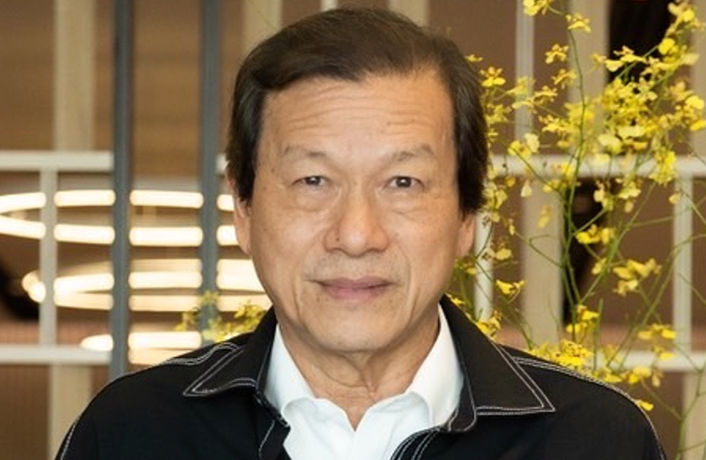
Apinan Poshyananda
(Chief Executive and Artistic Director, Bangkok Art Biennale)
Poshyananda was Director-General, the Office of Contemporary Art and Culture, Director-General, the Cultural Promotion Department and Permanent Secretary, Ministry of Culture, Thailand. He initiated the Silpathorn Art Award and Art fund for Thai artists. He commissioned the Thai Pavilion at the Venice Biennale (2003, 2005, 2007) and curated international exhibitions, including Asia-Pacific Triennial of Contemporary Art, Brisbane (Thai section, 1993, and Australian section, 1996); guest curator, "Heri Dono" (Japan Foundation, Tokyo, 2000); "Show Me Thai" (MOT, 2009); Bangkok Art Biennale (2018, 2020, 2022, 2024, 2026); "The Spirits of Maritime Crossing" at Venice Biennale (2024,2026).