Naoshima Meeting
2025
From Bringing to Venice What
Marco Polo Forgot to the
Naoshima New Museum of Art:
The Trajectory with Asian
Contemporary Art 1995–2025
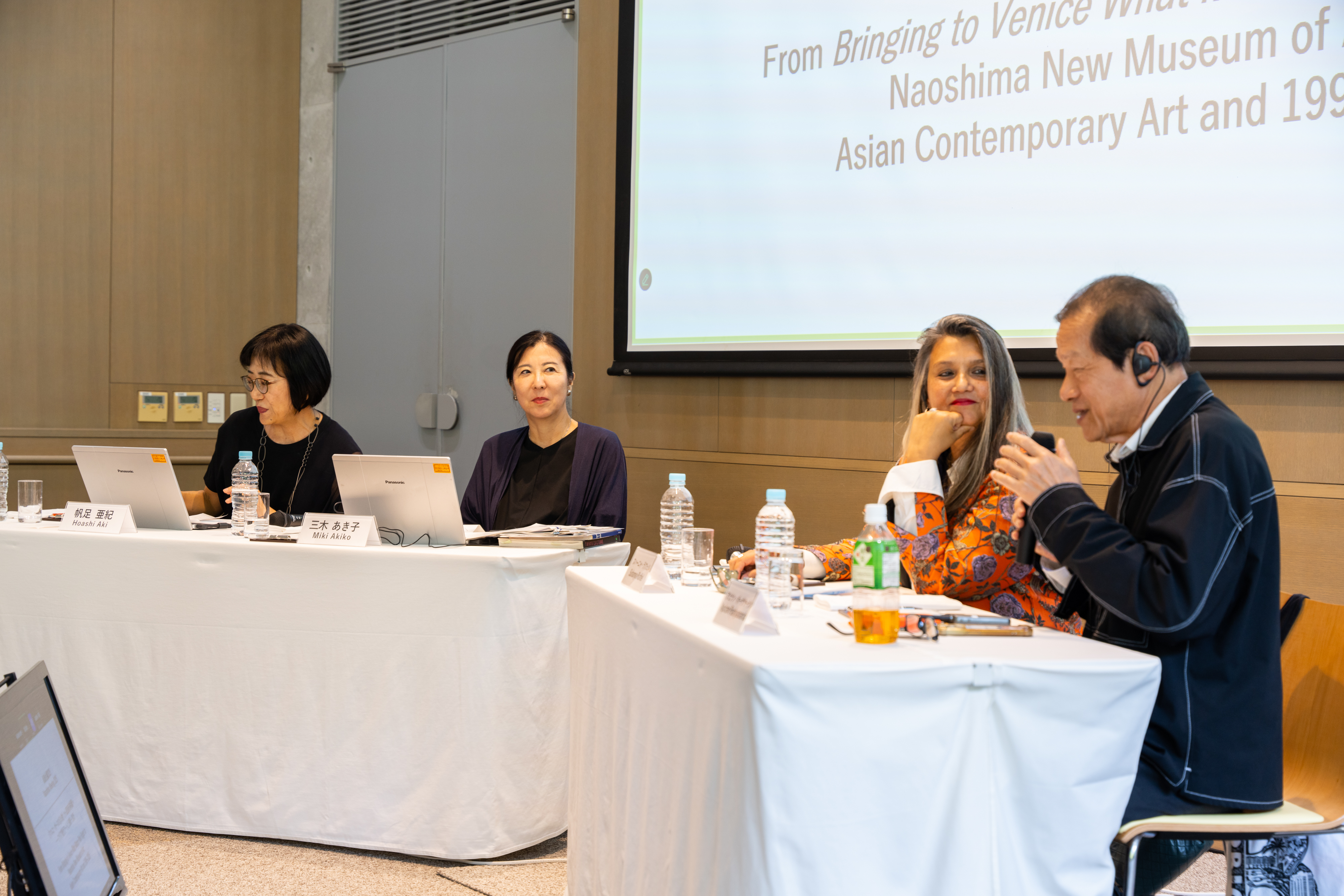
Naoshima Meeting
2025
From Bringing to Venice What
Marco Polo Forgot to the
Naoshima New Museum of Art:
The Trajectory with Asian
Contemporary Art 1995–2025
-
2. The Introductory Video of Bringing to Venice What Marco Polo Forgot by Cai Guo-Qiang
The Introductory Video of Bringing to Venice What Marco Polo Forgot by Cai Guo-Qiang.
Moving along the Grand Canal in Venice is an old Chinese sailing vessel. A ship sent from China by the artist Cai Guo-Qiang is being rowed by gondoliers toward the venue of the TransCulture exhibition. Marco Polo, who crossed the seas toward the East, was born here in Venice, and exactly seven hundred years before this Biennale, he returned to Venice from the Chinese city of Quanzhou. Quanzhou, in Fujian Province, is one of China's great historic and cultural cities. Marco Polo set out for his hometown of Venice from Quanzhou, which is also Cai Guo-Qiang's birthplace.
Inspired by Marco Polo's historic achievement, Cai Guo-Qiang proposed the work Bringing to Venice What Marco Polo Forgot. Cai has said that although Marco Polo brought back many exotic objects and stories from the East, he did not bring back the essential spirit of the East. For this reason, he conceived of sending out a ship loaded with traditional Chinese medicinal herbs as a symbol of that forgotten spirit, departing from the port of Quanzhou. Cai Guo-Qiang's planーto send a ship to Venice along the Maritime Silk Road in the present day, seven hundred years after Marco Polo's journeyーis a grand attempt to transcend time and space and to bring East and West into dialogue.
Cai Guo-Qiang speaking in the video:
Bringing to Venice What Marco Polo Forgot is also a symbol of the organic connection between human beings and nature. Traditional Chinese medicine, prescribed according to local conditions and climate, embodies an Eastern, holistic view of nature and its methodologies. It was also conceived as a way of bringing Eastern "ritual" or "magical" practices into Venice. Of course, medicine, divination, feng shui, and the like contain profound Eastern values and spiritual culture. In order to bring these to Venice, the very act of transporting medicinal herbs by sea, using a sailing ship that had come from my homeland, was made into a performance, delivering them through the canals of Venice. This is not a work to be merely "seen" or "heard." It is taken into the body, purifying and activating one's vital energy and spirit. The viewer's own body becomes part of the work.
The TransCulture exhibition was the first large-scale international exhibition in which I formally participated. From the outset, I wanted to create some kind of extraordinary, powerfully striking performance or event. At the time, I carried with me the earthiness and wild aura of Quanzhou, the smell of gunpowder, and, in addition, the confidence and organizational strength I had cultivated in Japan. Through participating in the Venice Biennale, I realized something for the first time in a truly tangible way: that art can reach people's hearts directly, transcending the barriers of language, culture, and politics; that it allows one to "play" together with people from different cultural backgrounds. Of course, this work also brought me prize money, which supported me through the difficulties of production and daily life at the time. Moreover, many Western curators who were involved in the judging, as well as many who came to see the exhibition, soon afterward invited me to participate in their own exhibitions.
From Quanzhou to Japan, the United States, and many other parts of the world, I have continued to move like a migratory bird. Flying back and forth from place to place over these years, I have witnessed changes in the world and, at the same time, experienced changes in my own life. My works contain feelings toward my homeland as well as personal emotions. What has remained constant is the proposition of dialogue with the natural world of the entire Earth, the vast cosmos, and the "invisible world." Looking back, Bringing to Venice What Marco Polo Forgot was like a single seed. Over a long artistic journey of thirty years, it has taken root in the soils of many different cultures and has continued to bloom.
Following my participation in 1995, I took part repeatedly in the Venice Biennale's thematic exhibitions in 1997, 1999, and 2001, and in 2005, I also curated the Chinese Pavilion. Venice became a place of good fortune for me. This marked the first time that the Chinese Pavilion participated in the Venice Biennale. Because I had participated many times before, I had established good relationships with the organizers and the Biennale president, which enabled me to help realize China's participation in the Biennale.
Venice's Rent Collection Courtyard, which I presented in 1999, also became a significant event. I invited the original sculptor to Venice and had the work produced on site, transforming a sculpture that would ordinarily be "viewed" into a performance of "making sculpture." I recreated a classic work from the socialist era and made the artist himself part of the work, turning him into an object to be viewed. The experience of looking at sculpture shifted into watching the process of making sculpture, and seeing the sculpture came to mean seeing the sculptor himself. This approach brought me the Golden Lion Award at the Venice Biennale.
I myself am someone who has benefited greatly from globalism and multiculturalism. At a time when globalization was advancing with great momentum, I created a work themed around a golf course. Multiple exhibition rooms were connected like a golf course, allowing visitors to move freely across the galleries while playing golf. At the time, I realized that even socialist countries had golf coursesーnot only in socialist states but all over the worldーand I was astonished to learn that there was even one in North Korea. I felt a sense of incongruity, and at the same time a certain absurdity. In response, I replaced all the flags on the golf course with the national flags of socialist countries, using the golf course installation to satirize the ubiquity of globalism. Looking back now, however, that satire may have contained a kind of optimism about globalization. Today, I find myself more inclined to lament the retreat of globalization.
In 2006, I presented Head On at the Guggenheim Berlin. The inspiration came from Berlin's history: ninety-nine wolves charge headlong into a glass wall the same height as the Berlin Wall. That glass wall symbolizes the barrier that once divided East and West Berlin. The work expresses the idea that even if visible walls can be destroyed, the "invisible walls" that exist between people, and between nations and cultures, are far more difficult to break down. In our current era, when globalism faces many challenges and movements toward isolation and conservatism are growing stronger, this workーwhich questions the invisible boundaries between individuals and culturesーhas, I believe, taken on deeper significance in a new age. Head On is currently on permanent display at the Naoshima New Museum of Art. Looking toward the future, I hope that audiences who encounter this work on Naoshima, including visitors from around the world, will continue to think critically and to question, and that they will reflect on the very nature of humanity itself and persist in that reflection.